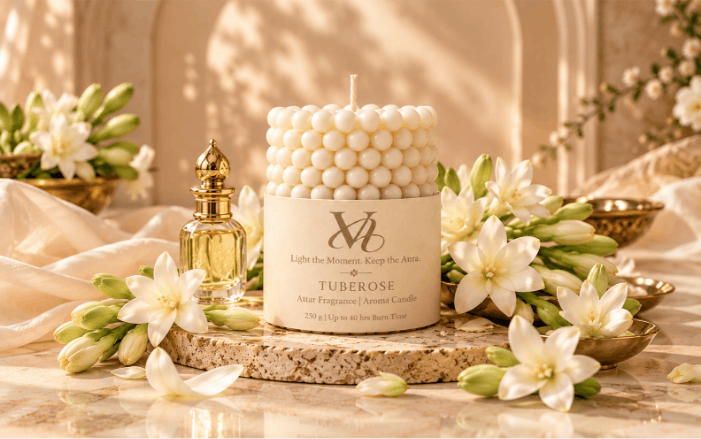
Some floral fragrances are easy to overlook. Tuberose is rarely one of them. Known for its rich white-floral character, this distinctive flower can smell creamy, sweet, green, and surprisingly complex, depending on how its fragrance is interpreted. In a scented candle, tuberose offers an alternative to lighter, more familiar florals. Discover what makes this flower so compelling, how its fragrance can shape the character of a room, and why Midnight Bloom Candle by Valk Aura deserves a place in the conversation about expressive home fragrance.
Explore a more expressive floral fragrance: Tuberose offers a fuller character than many people expect from a white flower, making it worth discovering if you enjoy distinctive floral scents.
Give your surroundings a recognisable scent identity: A tuberose-scented candle can introduce a noticeable floral element to your living space, depending on the blend and room conditions.
Find an alternative to familiar floral scents: If rose and jasmine are already part of your fragrance preferences, tuberose offers another direction to explore.
Complement evening settings: Its association with fragrant evening gardens makes tuberose an interesting choice for dinner, conversation, or a considered evening routine.
Make fragrance part of your home's character: A candle allows you to explore the relationship between scent, lighting, furnishings, and the atmosphere you enjoy living in.
A flower does not need to be large to leave an impression. Tuberose is a good example.
Its white blossoms may appear delicate, but their fragrance is anything but simple. Tuberose can be rich and creamy, sweet and floral, or greener and slightly sharper. Some interpretations have a warmth that brings to mind coconut milk; others reveal a more intense, almost heady floral character.
This complexity is what makes tuberose interesting in perfumery, and it is also what makes it worth exploring in home fragrance.
Think about the floral scents you already know. Rose often brings to mind petals, sweetness, or a familiar romantic association. Jasmine can be fresh, sweet, or intensely floral. Tuberose belongs to the same broad family of white florals, but its character can feel fuller and more pronounced. It does not always sit quietly in the background.
That does not mean it has to overpower a room. Its effect depends on the particular fragrance composition, the candle's scent strength, the size of the space, and how you use it.
Midnight Bloom Candle by Valk Aura takes its fragrance identity from tuberose, a flower with a character that goes well beyond the appearance of its blossoms. The name evokes the flower's association with evening gardens and its ability to make a memorable impression.
For those who enjoy floral fragrances but want something with a little more complexity to explore, tuberose offers a useful starting point.
The interesting question is not simply whether you like floral scents. It is which kind of floral character you want to experience in your home.
Tuberose has an unusual place in the world of fragrance. Unlike flowers whose scent is most readily described as delicate or fresh, tuberose is frequently associated with richness and intensity.
The plant is known botanically as Agave amica, also widely referred to by its older botanical name, Polianthes tuberosa. Its fragrant flowers have been used in floral arrangements and perfumery, and the plant is cultivated in India as well as other parts of the world.
In perfumery, tuberose is valued for the complexity of its aroma. Its fragrance can contain creamy, sweet, green, and warm facets, which explains why two compositions featuring tuberose can smell quite different from one another. <Cite refs={["turn830185search2","turn830185search4","turn830185search7"]}/>
The name itself can be misleading. Despite the word rose, tuberose is not a type of rose. It belongs to a different botanical family and has its own distinctive fragrance profile.
Its association with the evening also has a natural connection to the flower. Tuberose is known for its fragrant, evening-blooming flowers, a characteristic that has helped make it a familiar reference in descriptions of night gardens and white-floral perfumery. <Cite refs={["turn830185search0","turn830185search8"]}/>
There is another reason fragrance makers return to tuberose: it can be interpreted in multiple ways.
One composition may emphasise its creamy, sweet side. Another may bring forward its green facets, making it feel sharper and more unusual. A third may combine it with other floral materials to create something fuller and more rounded.
This range gives tuberose a distinctive role in fragrance storytelling. It is not simply another pleasant flower. It is a scent that invites closer attention.
With Midnight Bloom Candle, the idea is to bring that character into a home setting. Rather than treating floral fragrance as something reserved for bouquets or personal perfume, the candle offers a way to explore tuberose as part of the atmosphere of a room.
Fragrance family: White floral
Defining fragrance: Tuberose
Tuberose is often described as a rich white-floral scent, but that description only tells part of the story. Its different facets explain why the fragrance can feel both familiar and unexpected.
One of tuberose's defining qualities is its creamy character. Depending on the composition, the fragrance can feel smooth, rounded, and almost velvety rather than light and airy.
This is one reason tuberose can create a different impression from a floral fragrance dominated by fresh petals or green notes.
Tuberose can have a noticeable floral sweetness, but this is not necessarily the same as the sweetness of vanilla or a dessert-inspired fragrance.
Its sweetness is part of the flower's overall aromatic character. Other facets, such as greenery and warmth, can make the finished scent feel more complex.
Not every tuberose fragrance is dense or creamy. Some interpretations emphasise greener qualities, introducing a sharper, more natural impression alongside the floral sweetness.
These nuances help prevent tuberose from being reduced to one predictable scent description.
Certain tuberose materials and fragrance compositions have a warm or subtly spicy character. This can give the floral profile additional depth and make it feel more substantial than a straightforward fresh-floral scent.
Tuberose is often used alongside other white flowers, including jasmine and gardenia, because their characteristics can complement one another. However, tuberose has its own identity, and it need not be combined with other florals to make an impression. <Cite refs={["turn830185search0","turn830185search7","turn830185search9"]}/>
These are characteristics associated with tuberose as a fragrance ingredient. They should not be taken as a guaranteed list of notes in every tuberose-scented candle.
For Midnight Bloom Candle, tuberose is the defining fragrance reference. Its actual balance of creaminess, sweetness, freshness, and intensity depends on the attar blend used in the product.
This distinction is worth understanding when choosing a candle. The fragrance name tells you the central inspiration, but the full composition determines how that inspiration is expressed.
If you enjoy white florals with a noticeable presence, tuberose is a scent worth exploring. If you prefer very light, barely perceptible floral fragrances, you may want to pay particular attention to the actual scent description and fragrance strength before choosing it.
Some fragrances are chosen because they blend easily into their surroundings. Others are chosen because their character adds something distinctive to the space.
Tuberose often belongs to the second category.
Imagine an evening in which the details have been kept simple. The overhead lights are off, a table lamp illuminates one corner of the room, and dinner is almost ready. There may be music playing quietly, or the room may be silent apart from the sounds of the evening.
In a setting like this, a rich floral fragrance can become one of the details that makes the room feel considered.
Tuberose is particularly interesting because it can offer more than the familiar freshness associated with some white flowers. Its fuller character can create a different impression from a very light, green, or airy floral scent.
For someone who enjoys expressive fragrances, that richness may be precisely the appeal. It gives the scent something to explore beyond the initial floral impression.
For someone else, tuberose may be best enjoyed in a larger, well-ventilated room, or for a shorter period if they prefer less noticeable fragrance.
Neither preference is better. Fragrance is personal, and a scent that feels beautifully rounded to one person may be too intense for another.
Midnight Bloom draws on the more expressive side of floral fragrance. Its name suggests a flower after dark, but its place in your home does not need to be limited to night-time. You might choose it for an evening with guests, a quiet dinner, or a moment when you simply want the room to have a more distinctive scent.
The appeal of tuberose is its character: floral, recognisable, and capable of offering more than one impression depending on how the fragrance is composed.
The living room is a useful starting point for exploring a distinctive floral candle. There is usually enough space to notice how the fragrance develops without placing it directly beside the activity taking place.
Midnight Bloom Candle may be worth considering if you enjoy a more expressive floral scent while reading, listening to music, or spending time with family and friends.
Begin with a shorter burning session, particularly if you are unfamiliar with tuberose or prefer a more restrained fragrance experience.
Tuberose has a natural association with evening fragrance, making it an interesting option when preparing a room for dinner or conversation.
Keep the candle away from the dining table if the fragrance is noticeable enough to compete with food aromas. Fragrance should complement the occasion rather than become the centre of attention.
A favourite chair, a good lamp, and a little uninterrupted time can make a corner of the home feel distinct from the rest of the room.
A tuberose-scented candle can contribute to that setting if you enjoy floral fragrances with more depth. Consider how the scent interacts with the size of the space and any other fragranced products nearby.
Open-plan rooms can be challenging when choosing home fragrance because the scent may travel across several areas. A fragrance that seems balanced in one corner may become more noticeable throughout the entire space.
If you use Midnight Bloom in an open-plan room, consider the room's ventilation and how much fragrance you prefer. You do not need to use a candle for a long period to evaluate whether its scent suits your home.
A distinctive fragrance can become part of the setting when guests arrive. Tuberose may appeal to those who enjoy fuller white-floral scents, but it is worth remembering that guests may have different preferences or sensitivities to fragrance.
Use a measured approach and allow adequate ventilation. A welcoming environment does not need to be heavily scented.
Midnight Bloom Candle may be considered for someone who enjoys expressive white florals or likes discovering fragrance profiles beyond rose and jasmine.
It is especially worth considering when the recipient appreciates the character of a scent rather than simply preferring the lightest available fragrance. As with any scented gift, their preferences are the best guide.
Candle safety matters wherever you use it. Keep the candle on a stable, heat-resistant surface, away from curtains, bedding, drafts, children, and pets. Never leave a burning candle unattended, and extinguish it before leaving the room or going to sleep.
A fragrance such as tuberose rewards a more thoughtful approach to choosing a candle.
Its character can vary considerably depending on the materials used and how they are blended. Some interpretations highlight a creamy, rounded floral profile; others emphasise green freshness or a more intense white-floral character.
For that reason, the most useful description of a tuberose candle is not simply that it smells floral. It is how that floral character is expressed, how noticeable the fragrance is, and whether it fits the space in which you plan to use it.
Midnight Bloom Candle belongs to the Valk Aura collection of attar-infused candles, with tuberose as its defining fragrance inspiration. Its name points towards the more expressive side of floral fragrance, offering a different direction for those who want to explore beyond the familiar character of rose.
When choosing a candle, consider the actual fragrance description alongside the size of your room and your personal preference for scent intensity. These details will tell you more about whether the candle belongs in your space than a broad promise about how it should make you feel.
The quality of the experience also depends on the product itself. Its actual fragrance formulation, wax composition, wick, burn time, and recommended use should be understood from verified product specifications rather than assumed from the fragrance name.
That is the detail worth paying attention to: not an elaborate description of a flower, but a clear understanding of what the candle is designed to offer.
A tuberose fragrance does not need to be for everyone. Its appeal lies partly in its distinctive character, and choosing it makes most sense when that character is something you genuinely enjoy.
Midnight Bloom Candle is for those who want to explore the more expressive side of floral home fragrance, where the appeal of a flower lies as much in its depth and complexity as in its delicate appearance.
What does tuberose smell like?
Tuberose is generally described as a rich white-floral fragrance. Depending on the variety and composition, it can smell creamy, sweet, green, warm, or slightly spicy. Some interpretations are dense and heady, while others emphasise fresher, greener qualities.
Is tuberose the same as rose?
No. Tuberose is botanically different from a rose, despite the word rose in its name. Tuberose is commonly used in white-floral perfumery and has a distinctive scent profile that can be creamy, sweet, and green.
Why is tuberose associated with the evening?
Tuberose is known for its fragrant flowers, and the plant is associated with evening-blooming flowers and night gardens. This has influenced its place in fragrance descriptions and its association with evening settings. The exact fragrance intensity varies with the plant variety and growing conditions.
Is tuberose a strong floral fragrance?
Tuberose is often considered an expressive or intense floral note, although the finished fragrance can vary considerably. The strength of a tuberose-scented candle depends on its formulation, fragrance concentration, candle design, and the room in which it is used.
Where should I use a tuberose-scented candle?
A tuberose candle may suit a living room, a reading corner, or an evening setting, depending on your preference for floral intensity. Start with a shorter burning session and assess how noticeable the scent becomes in the space.
What is the difference between Midnight Bloom Candle and other floral candles?
Midnight Bloom is inspired by tuberose, a white-floral note known for its rich and varied character. Rose, jasmine, and other floral ingredients have their own distinctive profiles. The best comparison depends on the actual formulation and scent characteristics of each candle.
Is Midnight Bloom Candle a good gift?
It may be a considered gift for someone who enjoys expressive floral fragrances and likes exploring scents beyond more familiar floral choices. The recipient's preferred scent intensity and fragrance preferences are important factors when selecting a candle.